


Volume before judgment
Most of the first two weeks go into reading and reconciling. The questions that decide the deal come last, when there is the least time for them.
Needl.ai reads every document in a private equity or private credit data room, validates the model against the source data, benchmarks the financials and flags what matters. A first pass in around 30 minutes, a fully cited investment committee memo in hours, and findings linked to the passages behind them.
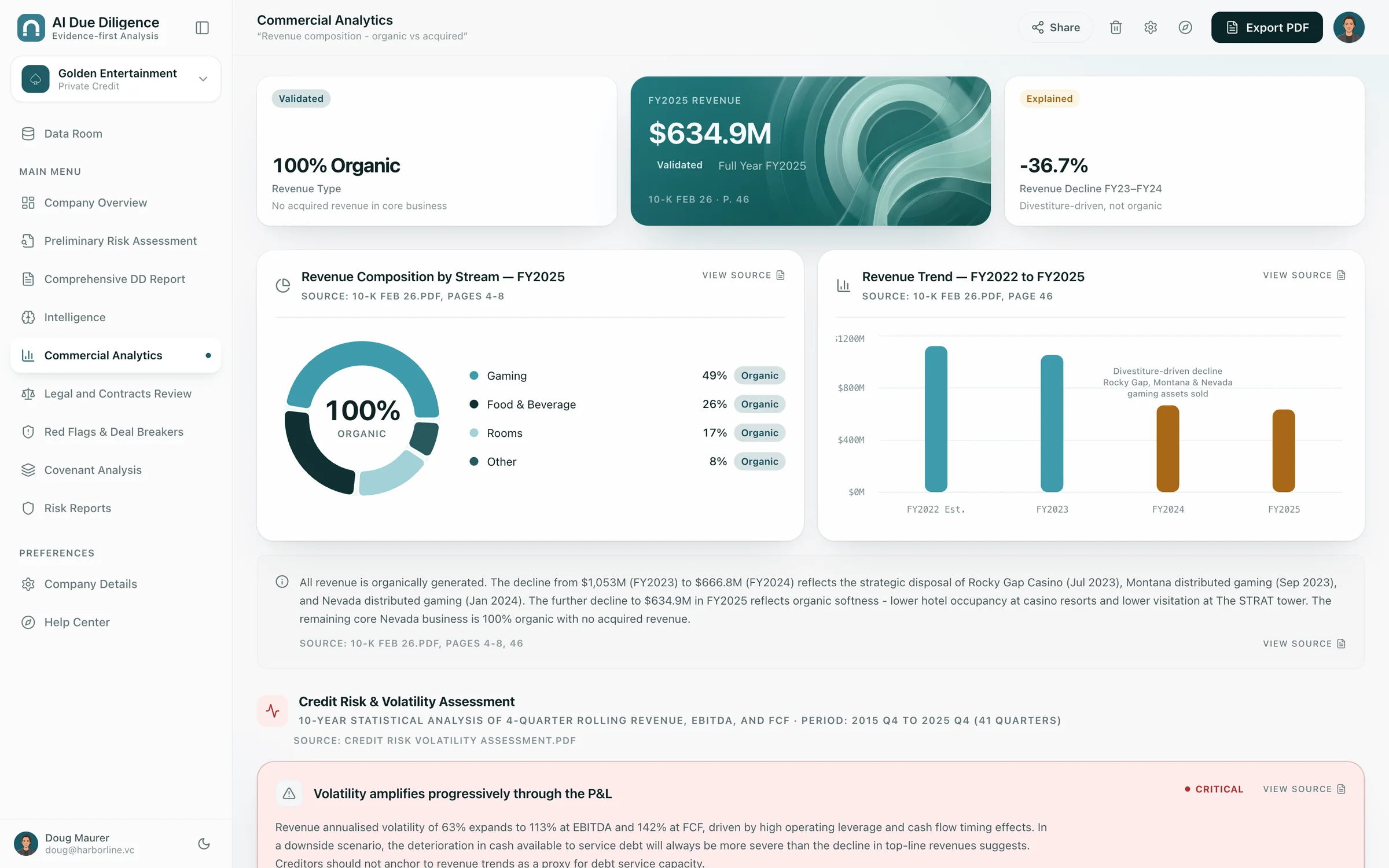
A data room lands with a few hundred files and a committee date. Contracts, models, decks and disclosures get read one at a time, numbers get rebuilt in spreadsheets, and the clause that changes the thesis turns up late, if it turns up at all.
Most of the first two weeks go into reading and reconciling. The questions that decide the deal come last, when there is the least time for them.
The CIM, the model and the filings rarely tell the same story. A projection the underlying data cannot support is easy to miss when the checks are manual.
Risks live in emails, notes and slides. When the committee asks where a finding came from, someone goes back to the room to look.
The same room, read by Needl.ai, comes back as a first pass, a validated model, a consolidated risk view and a memo, in that order.
A go / no-go checklist and the risk flags that matter, around 30 minutes after the room is loaded.
Projections checked against the underlying data, with every mismatch surfaced before the IC discussion.
Commercial drivers, partnership dependencies, legal and covenant exposure and IP risk, consolidated and ranked by severity.
Thesis, risks, financial validation and recommendation in your format, with each conclusion linked to its evidence.
How a deal moves through Needl.ai, start to finish.
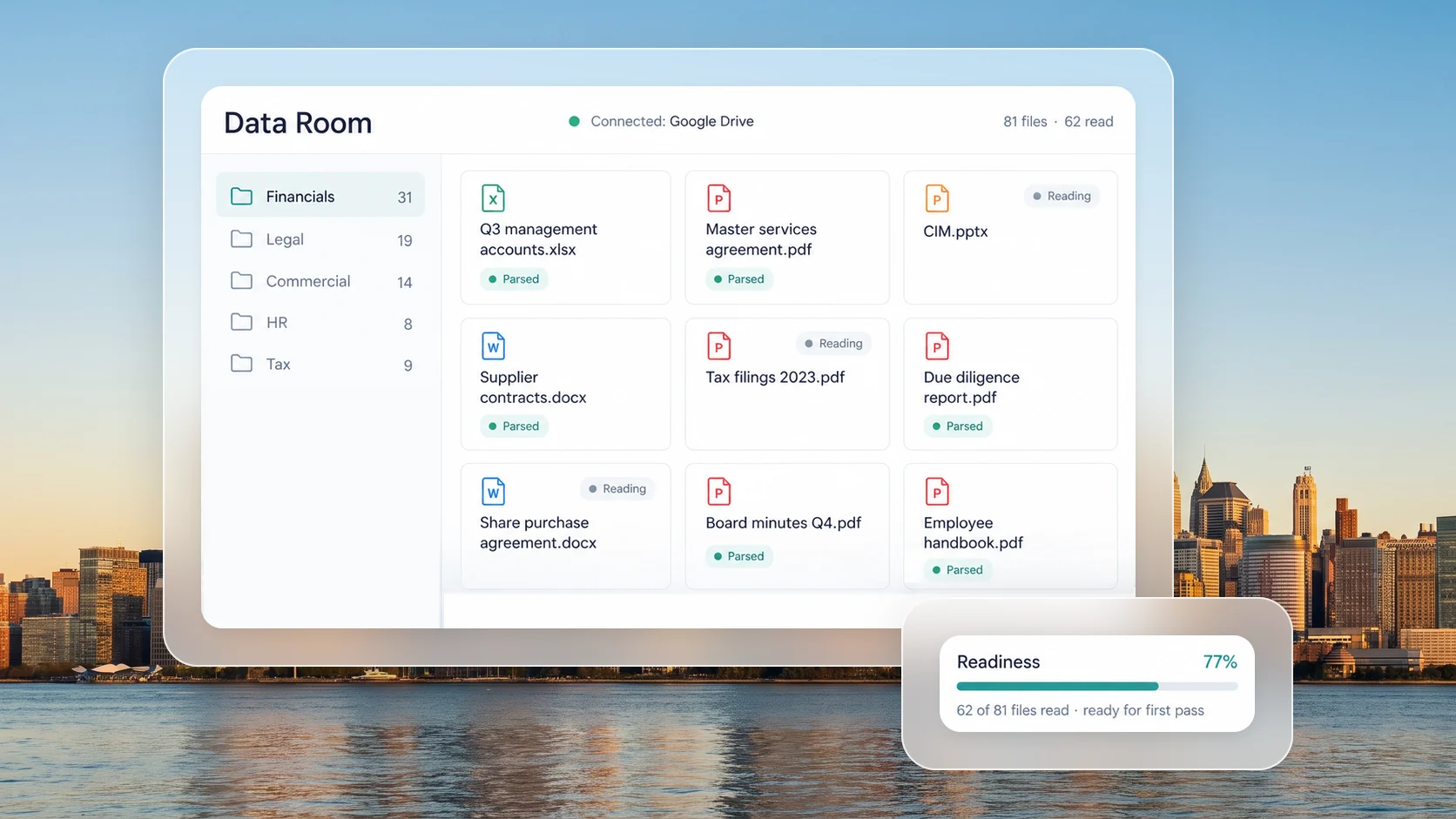
Upload the files or connect the drive the room lives in. Contracts, financial models, partnership agreements, employee documents and investor decks are read, classified and indexed, and a connected view of the deal is ready in minutes.
You getA readiness view of every file in the room.
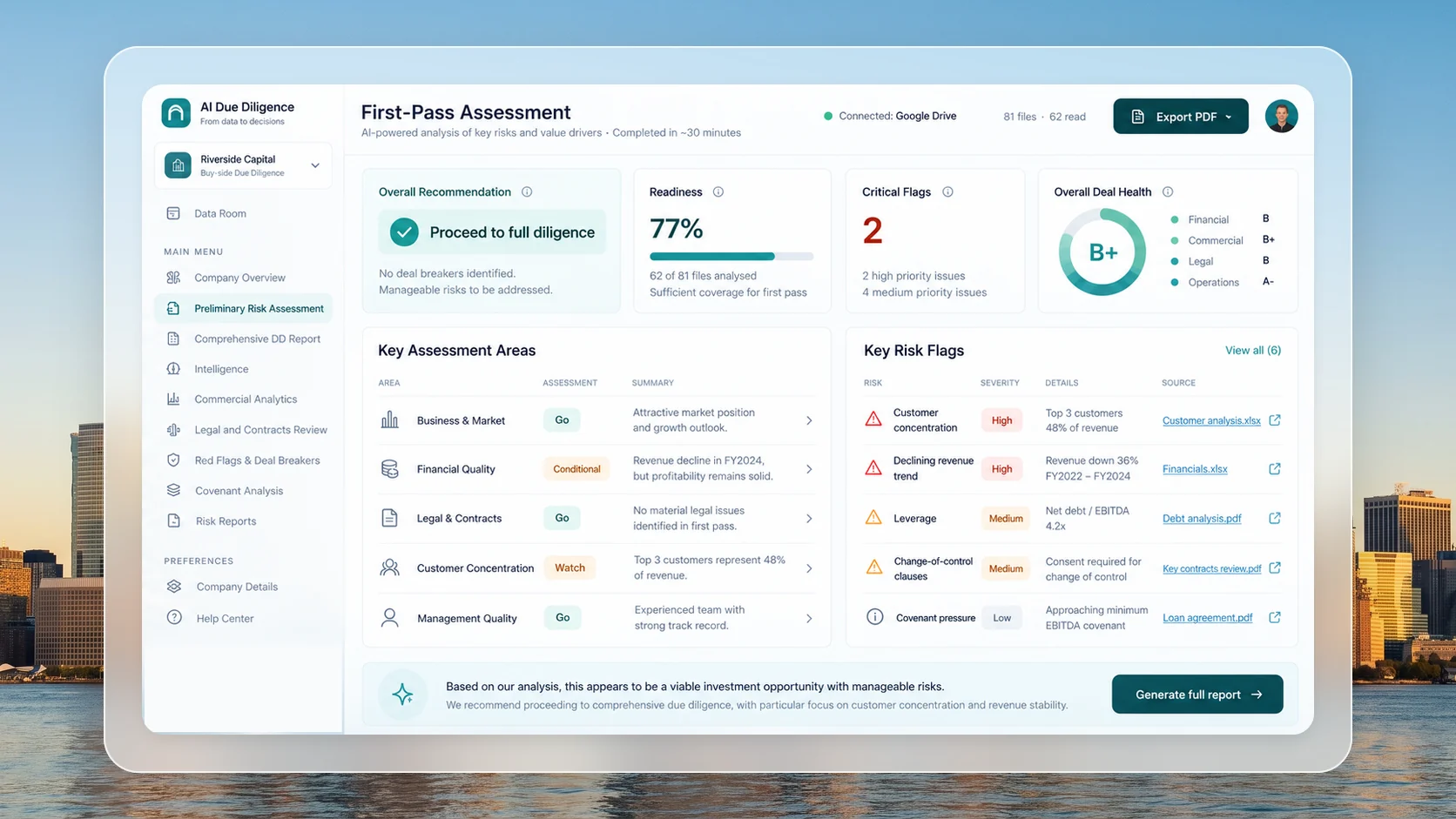
In around 30 minutes Needl.ai returns a first-pass diligence assessment: a go / no-go checklist across the business and the flags that decide whether the deal deserves the full workflow.
You getA go / no-go checklist and the key risk flags.
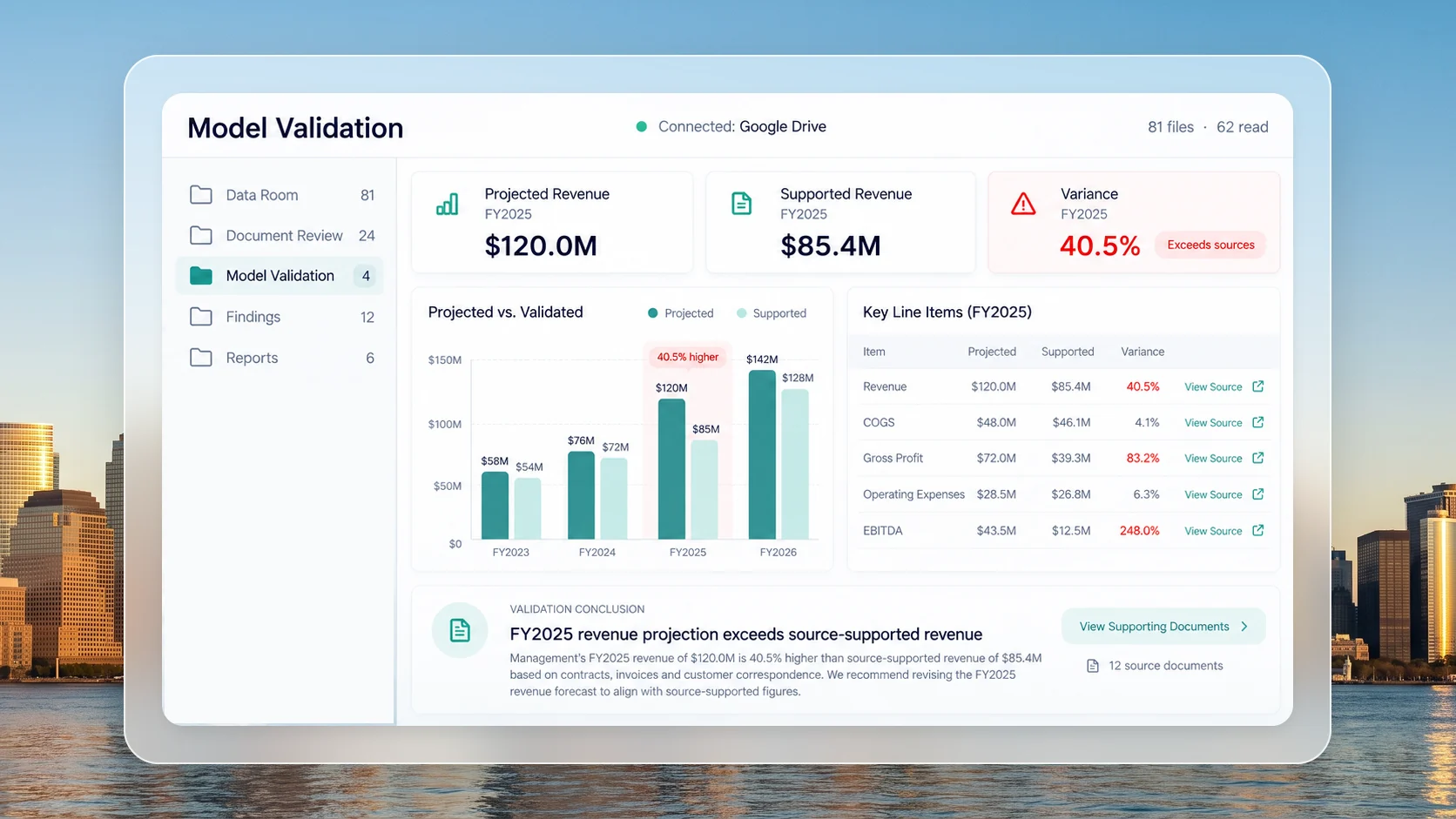
The financial model is checked against the underlying data. Inconsistencies are caught here, like a projected $20M in revenue against a realistic $2M.
You getA validated model with every mismatch flagged.
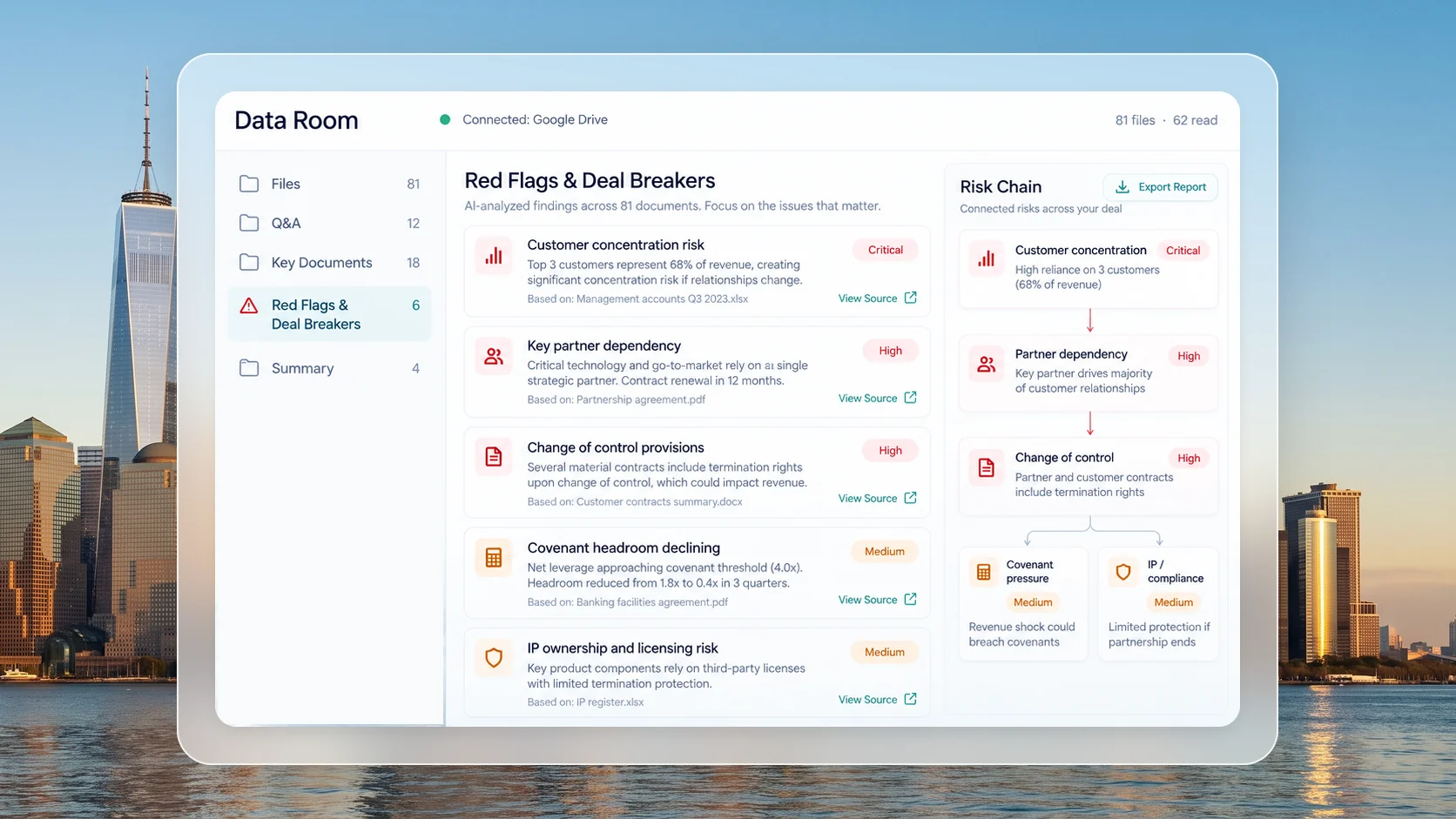
Commercial drivers, partnership dependencies, legal and covenant exposure and IP risks are reviewed automatically and consolidated into one ranked view, each with its observed evidence and a recommended action.
You getA consolidated risk and red-flag report.
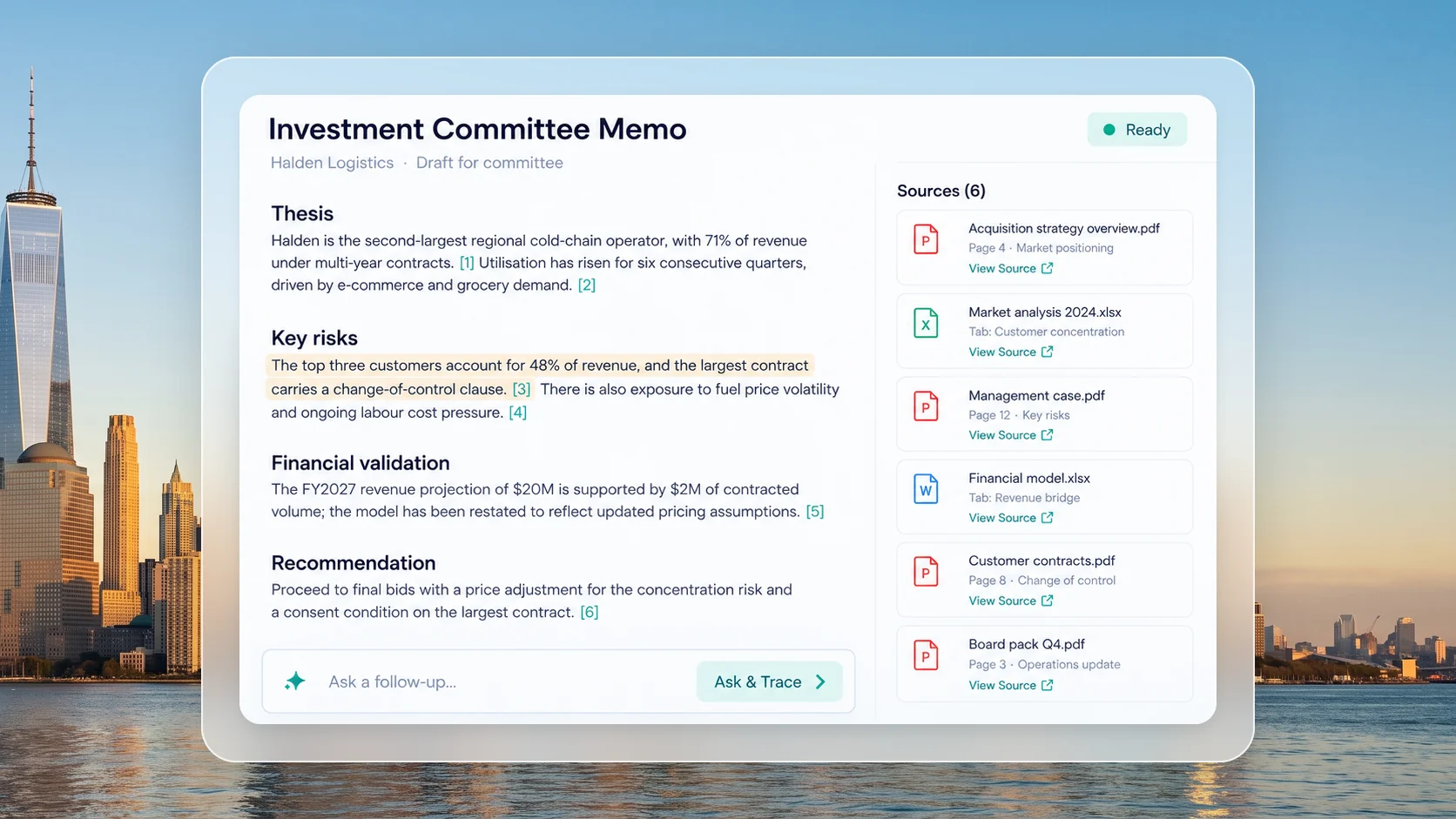
A fully cited investment committee memo, with thesis, risks, financial validation and recommendation, in your preferred format. Analysts dig deeper with follow-up questions and trace every conclusion back to the supporting evidence.
You getA cited IC memo, exported as a document.
Real rooms run to hundreds of files across dozens of folders, and they keep changing until the week of the committee. Needl.ai syncs the room from its drive, catalogues it, and gives each section of the diligence its own analyst agent that searches the room through the context layer.
Connect the Google Drive or OneDrive folder the room lives in. A large room syncs in the background, in batches, and picks up where it left off. Each file can be used as soon as it has been read.
A spreadsheet agent opens every tab of your Excel and Google Sheets models, reads the exact cell values and cites the sheet and range each figure came from.
The room is catalogued first. Each section of the report is then researched by its own analyst agent, which searches the room for its evidence, so a larger room never has to fit into one prompt.
New and edited files sync in on their own. Needl.ai shows what has changed since your last analysis, and the previous version stays readable while you update it.
The workspace is organised the way a deal team works: one page per question, with figures linked to their sources.
Upload or connect the room. Files are classified, parsed and indexed, and you can see what has been read before anything runs.
The business, its ownership and its capital structure, summarised from the documents with sources.
Revenue composition, trends, concentration and margin, charted from the room and linked to the source each number came from.
Projections checked against the underlying data. Mismatches are flagged with the figures side by side.
Critical and high findings with the observed evidence, the condition, the analysis and a recommended action. Linked flags form a risk chain.
Contract review with the clauses that matter, and covenant health: leverage, coverage and headroom, with what-if scenarios.
Preliminary risk assessment and consolidated risk reports, ready to circulate before the full memo lands.
The comprehensive due diligence memo, in your structure. Export it as a document or share a link with the deal team.
Figures link to the passage behind them, with the quote highlighted. Follow-up questions are answered from the room, with citations you can open.
“81 files became a connected view in minutes. A first-pass assessment landed in 24 minutes, and the platform caught a ~$20M revenue projection against a realistic ~$2M, plus $60-75K in external advisory and legal costs avoided.”
“Leverage, interest coverage, free cash flow, asset coverage, and covenant health surfaced in a single view, with what-if scenarios and a cited IC memo in under 30 minutes.”
Needl.ai runs in your own AWS or Azure account, or fully on premise. Your keys, your permissions and your egress rules apply, and no document leaves your perimeter.
 AICPA SOC 2
 ISO 27001 certified
 ISO 42001 in progress
 GDPR compliant
 CASA assessed
What deal teams ask before running live diligence on Needl.ai.
AI due diligence uses AI agents to read a deal's data room, check the model and the numbers against the source documents, flag the risks and draft the investment committee memo, so the deal team spends its time on judgment rather than reading. On Needl.ai, an analyst agent works through each section of the report, findings link to the passages behind them, and it can run inside your own cloud account. Our buyer's guide compares the main AI due diligence platforms.
Most teams get a first-pass assessment around 30 minutes after loading the data room, including a go / no-go checklist and key risk flags.
Needl.ai checks projections against the underlying model and source data, then highlights mismatches so analysts can verify assumptions before the IC discussion.
Yes. It compiles a fully cited IC memo with thesis, risks, validation findings and recommendations in your preferred structure, and exports it as a document you can circulate.
Yes. Conclusions link back to the underlying document evidence, so follow-up questions can be answered quickly and transparently.
Full virtual data rooms (VDRs): CIMs, financial models and projections, contracts and credit agreements, partnership and legal agreements, investor materials and disclosures. Upload the files or connect the drive the room lives in.
Yes, including direct lending. Choose private credit as the deal type and the analysis adds a covenant analysis for the lender: it reads the credit agreement and sets out the covenant register, headroom on the financial covenants, the claim priority across the capital structure, and amendments and waivers. The IC memo carries the same points, with no lend or don't-lend verdict.
In your own AWS or Azure account, or fully on premise. Your keys, your permissions and your egress rules apply, and no document leaves your perimeter.
A sourced figure or finding opens the passage it came from, with the quote highlighted, and the full document is one click away, so a reviewer checks the evidence instead of trusting the model.
On your own data, in your environment. Bring a live deal or a closed one and watch the first pass, the model validation and the memo come back.
